

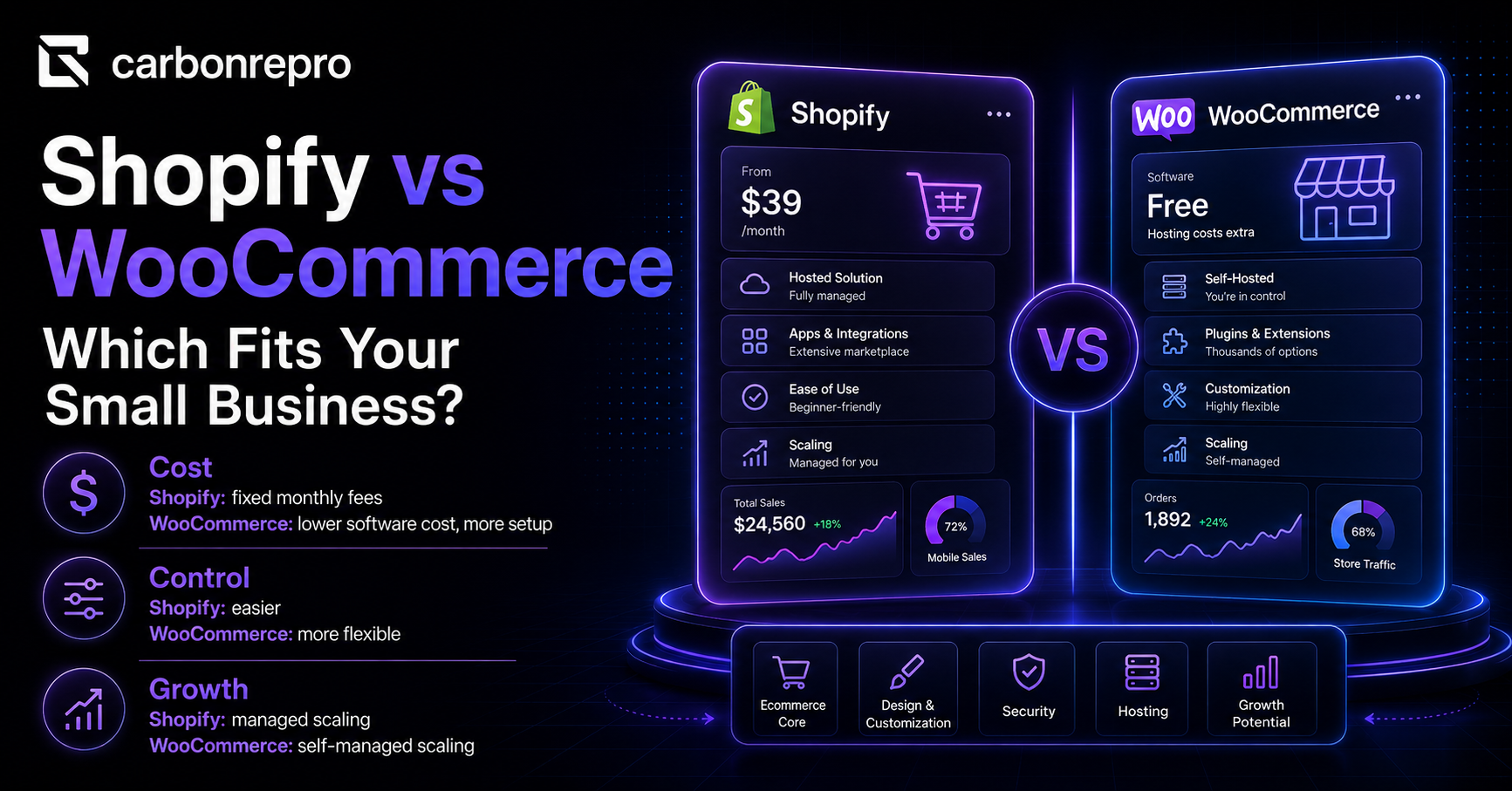
Shopify vs WooCommerce for small business comes down to one trade-off. Shopify hands you a finished platform with fixed monthly fees. WooCommerce hands you control over a WordPress site, along with the setup work that comes with it.
Neither platform beats the other in every case. The right pick depends on your budget, your comfort with tech, and how far you plan to grow.
What Is the Real Difference Between Shopify and WooCommerce?
Shopify is a hosted platform. The company runs the servers, handles security updates, and keeps the store online. You log in, add products, and sell.
WooCommerce is a plugin added to a WordPress site. You, or a developer, choose the hosting, install the plugin, and manage updates. Nothing runs behind the scenes without your input.
This single difference shapes almost everything else in the Shopify vs WooCommerce for small business decision, from monthly cost to how much freedom you have over design and features.
Shopify vs WooCommerce Cost Comparison
Shopify charges a flat monthly fee, starting around $39 per month for the Basic plan and rising past $399 for larger stores with advanced reporting. On top of that, Shopify takes a transaction fee unless you use its own payment processor.
WooCommerce itself costs nothing to install. Your real spend goes toward hosting, a domain, a security certificate, and any paid extensions your store needs, such as advanced shipping tools or subscription billing. Monthly costs often land between $20 and $100 for a small store, though they climb fast once you add premium themes and plugins.
At first glance, WooCommerce looks cheaper. Once you factor in developer time for setup, updates, and troubleshooting, the gap narrows. A business without in-house tech support often pays a developer or agency to keep a WooCommerce store running smoothly, which adds hidden cost most owners miss during the Shopify vs WooCommerce cost comparison stage.
Which Ecommerce Platform Is Easiest to Manage
Shopify wins here for most first-time store owners. The dashboard walks you through product setup, shipping rules, and payment options without touching code. Support sits one chat message away, day or night.
WooCommerce asks more of you. Since it runs on WordPress, you manage plugin updates, monitor for conflicts between extensions, and handle backups yourself, unless you pay a managed hosting provider to cover those tasks.
If you want a platform running with minimal upkeep, Shopify fits. If you already run a WordPress site and want full command over every setting, WooCommerce rewards the extra effort with flexibility Shopify locks behind its own app store.
Best Ecommerce Platform for Small Business: How to Decide
There is no single best ecommerce platform for small business. The right answer depends on three questions.
How much time do you have? Shopify launches faster, often within days. WooCommerce takes longer to set up correctly, especially with custom design work.
How much control do you want? WooCommerce gives you the WordPress codebase to adjust however you see fit. Shopify keeps you inside its ecosystem, which limits deep customization unless you build a custom app.
What does your product catalog look like? Large catalogs with complex variants often run smoother on WooCommerce with the right plugins. Simple catalogs with a handful of products launch cleanly on either platform.
Answer those three honestly, and the decision usually becomes clear without needing to weigh dozens of smaller features.
WooCommerce vs Shopify in 2026: What Changed
Both platforms shipped real upgrades over the past year. Shopify expanded its built-in AI tools for product descriptions and customer support, narrowing a gap that once favored third-party WooCommerce plugins.
WooCommerce, meanwhile, pushed deeper into block-based page building through WordPress, making custom storefronts easier to build without hiring a developer for every layout change.
The WooCommerce vs Shopify in 2026 landscape looks closer than it did a few years back. Shopify still wins on ease of use. WooCommerce still wins on raw flexibility and lower long-term software cost for businesses with technical support already in place.
Growth and Scaling: Which Platform Wins Long Term
Shopify scales cleanly for most retail businesses. Its infrastructure handles traffic spikes during sales events without extra setup on your end, and its plan tiers grow alongside your revenue.
WooCommerce scales too, though the responsibility shifts to you or your hosting provider. A high-traffic WooCommerce store needs solid hosting and caching to avoid slowdowns, since the platform lacks Shopify’s built-in infrastructure.
Neither platform caps your growth outright. The difference sits in who manages that growth. Shopify manages the backend for you. WooCommerce leaves the backend in your hands, along with the savings and control that come with it.
Signs You Should Choose Shopify
A few signals point toward Shopify as the stronger fit.
You want a store online within days, not weeks, and prefer a guided setup over a blank canvas.
You lack an in-house developer and want built-in support instead of hunting for freelance help every time something breaks.
You value predictable monthly costs over the lower, though less certain, long-term cost of a self-hosted platform.
Signs You Should Choose WooCommerce
A different set of signals points toward WooCommerce.
You already run a WordPress site for content or blogging and want your store integrated into the same platform.
You want full control over design, checkout flow, and functionality, without waiting on a platform’s app store to offer the feature you need.
You have access to a developer, either on staff or through an agency, who keeps the site updated and secure over time.
FAQ
Is Shopify or WooCommerce cheaper for a small business?
WooCommerce costs less in software fees, though it often costs more in developer time. Shopify costs more monthly but includes hosting, security, and support in that price.
Which ecommerce platform is easiest to manage for a beginner?
Shopify is easiest for most beginners, since it handles hosting, updates, and security without requiring technical knowledge from you.
Can I switch from WooCommerce to Shopify later, or the other way around?
Yes. Both platforms support product and customer data exports, though a full migration takes planning to avoid losing SEO rankings or order history during the switch.
Does Shopify vs WooCommerce for small business depend on store size?
Yes. Small catalogs run well on either platform. Larger, complex catalogs with heavy customization often favor WooCommerce, while simpler catalogs favor Shopify’s speed to launch.
Which platform is better for SEO?
Both platforms support strong SEO practices. WooCommerce, built on WordPress, offers deeper content and blogging tools out of the box, which some businesses use to build organic traffic alongside their store.



 Powered by