

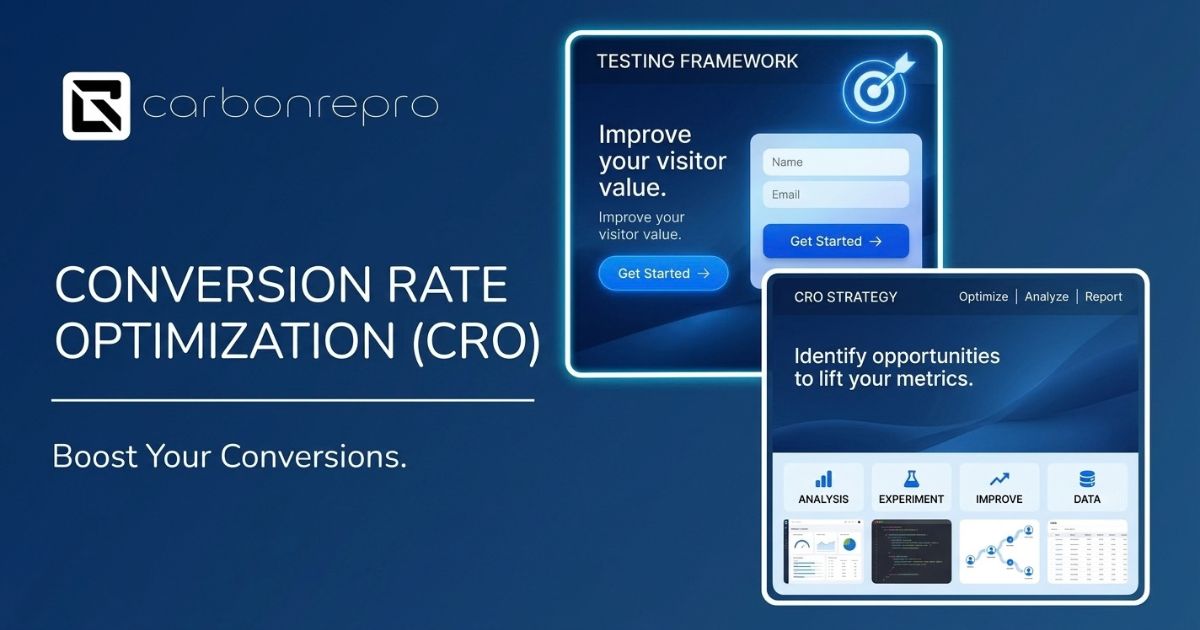
Most businesses spend far more energy trying to get new website visitors than they spend improving what happens once those visitors actually arrive. Conversion rate optimization flips that focus, and it is often the fastest way to get more customers without spending another dollar on traffic.
This guide explains what conversion rate optimization is, how it is measured, and where to start improving it.
What Is Conversion Rate Optimization?
Conversion rate optimization, often shortened to CRO, is the process of increasing the percentage of website visitors who complete a specific goal, like making a purchase, filling out a form, or booking a call. Instead of focusing on getting more traffic, CRO focuses on getting more value out of the traffic you already have.
How Is Conversion Rate Calculated?
Conversion rate is calculated by dividing the number of visitors who completed the goal by the total number of visitors, then multiplying by 100. If 1,000 people visit a page and 30 of them fill out a contact form, that page has a 3 percent conversion rate.
Why Does Conversion Rate Optimization Matter?
It Gets More Value From Traffic You Already Have
Improving your conversion rate means more customers from the same amount of traffic, which is usually far cheaper than trying to attract more visitors through ads or content.
It Lowers Your Cost Per Customer
If a landing page converts twice as well after optimization, your cost to acquire each customer through that page effectively drops in half, since you are paying the same amount for traffic but getting more conversions from it.
It Often Reveals Bigger Problems
The process of improving conversions frequently uncovers issues that were quietly hurting the business all along, like confusing navigation, slow page load times, or a checkout process with too many steps.
What Parts of a Website Does CRO Cover?
CRO is not limited to one page. It touches nearly every part of a site that asks a visitor to take action.
Landing Pages
Landing pages built for a specific offer or ad campaign are one of the most common and easiest places to run CRO tests, since they usually have one clear goal to measure against.
Homepages
A homepage juggles many goals at once, so CRO here often focuses on clarifying the message and making the most important action easier to find.
Product and Service Pages
These pages benefit from clear pricing, strong trust signals like reviews, and calls to action that are easy to spot without scrolling too far.
Forms and Checkout
Every extra field in a form is a chance for someone to give up. Simplifying forms and checkout steps is one of the most reliable ways to lift conversions.
How Do You Actually Improve Conversion Rate?
Start With Data, Not Guesses
Look at where visitors are actually dropping off using analytics tools before changing anything. Guessing what to fix without data usually wastes time on changes that do not move the needle.
Simplify the Call to Action
A page with one clear action almost always outperforms a page asking visitors to choose between several competing options. Decide what you most want a visitor to do, then make that the obvious next step.
Reduce Friction
Fewer form fields, fewer clicks, and fewer distractions all tend to raise conversion rates. Every extra step you can remove between interest and action helps.
Build Trust Quickly
Reviews, testimonials, clear contact information, and real photos all help a visitor feel confident enough to take action, especially on a page they are seeing for the first time.
Test Changes One at a Time
Changing a headline, an image, and a button color all at once makes it impossible to know which change actually helped. Testing one element at a time gives you a clear answer.
How Is CRO Different From Landing Page Optimization?
Landing page optimization is a smaller, more focused piece of conversion rate optimization. CRO applies to your entire website, from your homepage to your checkout flow, while landing page optimization narrows in on improving a single page built for a single campaign.
Common Conversion Rate Optimization Mistakes
Testing without enough traffic. Small changes on low-traffic pages can take a long time to produce a reliable result, so prioritize your highest-traffic pages first.
Chasing small wins while ignoring bigger problems. A slow-loading page or a broken checkout step will undermine every other CRO effort until it gets fixed.
Making too many changes at once. Without isolating one variable at a time, it becomes impossible to know what actually caused a change in results.
Optimizing for clicks instead of real conversions. A version of a page that gets more clicks but fewer actual sales or leads is not an improvement, even if the early numbers look promising.
Frequently Asked Questions
What is conversion rate optimization?
Conversion rate optimization is the process of increasing the percentage of website visitors who complete a specific goal, like a purchase or a form submission, by improving the experience on your site rather than driving more traffic to it.
How do you calculate conversion rate?
Divide the number of visitors who completed the goal by the total number of visitors, then multiply by 100. For example, 30 conversions out of 1,000 visitors equals a 3 percent conversion rate.
What is a good conversion rate?
It varies widely by industry and page type, so the most useful comparison is usually your own page’s performance over time rather than a fixed number.
Is CRO the same as A/B testing?
A/B testing is one common method used within CRO, where two versions of a page are compared to see which converts better. CRO is the broader practice that A/B testing is one tool for.
Where should a business start with conversion rate optimization?
Start with your highest-traffic pages, since even small improvements there produce a bigger overall impact than the same improvement on a low-traffic page.
Want Help Turning More Visitors Into Customers?
Carbonrepro builds conversion-focused web design and landing pages as part of our services, and we track results against real ROI data rather than vanity metrics. Reach out and we can take a look at where your site is currently losing visitors before they convert.
 Powered by