

You want more calls and sales from Google. But when you ask what it costs, the answers are all over the place. One agency says $500. Another says 15 percent. A third wants a long contract.
It gets confusing fast. This guide keeps it simple. You will learn how agencies charge, what a fair price looks like at your budget, and what to ask before you sign.
One quick note first. The numbers below come from ranges shared in public pricing guides from several agencies. Your real quote may be higher or lower. Use these numbers to spot a fair deal, not as a hard rule.
How much does Google Ads management cost?
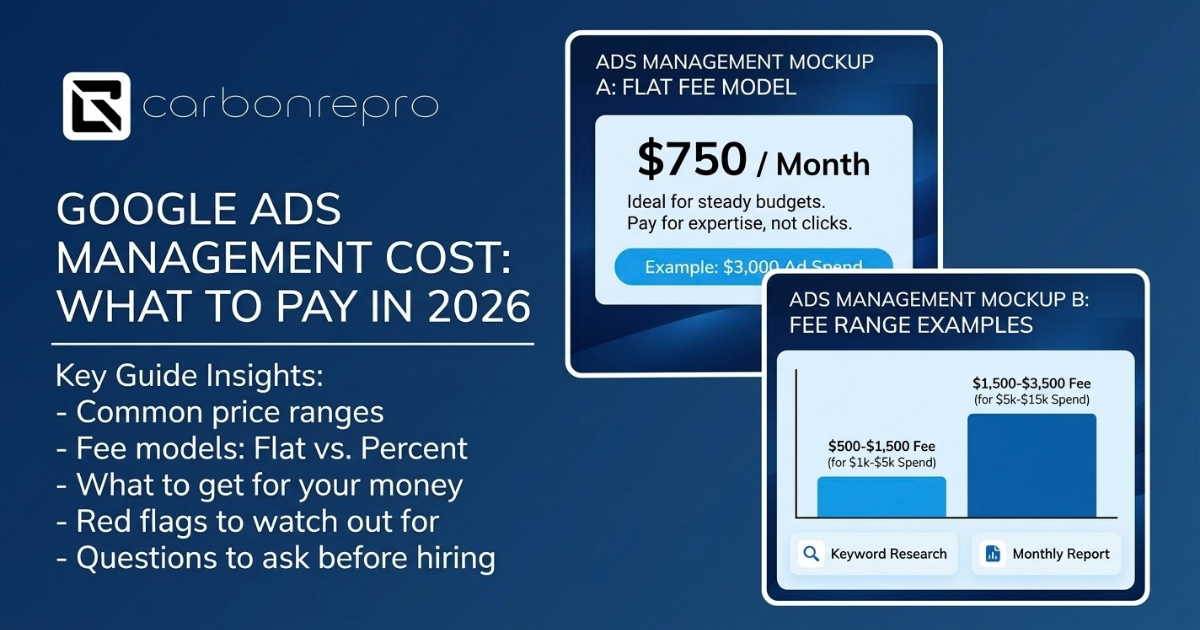
Most small businesses pay between $500 and $1,500 a month in management fees when they spend $1,000 to $5,000 a month on ads. Mid-size accounts often pay more. This fee pays for the work of running your account. It does not pay for the clicks.
Think of it like hiring a driver for a delivery truck. The fee pays the driver. The ad budget is the gas. You pay both, and they are two different bills.
The range is wide because the work is not the same for every business. A plumber with one service area needs less work than a store with 2,000 products. More products, more locations, and more goals all mean more time.
What are the main ways agencies charge for Google Ads?
Agencies usually pick one of four models: a flat monthly fee, a percent of your ad spend, a mix of both, or an hourly rate. Some also add a one-time setup fee. Each model fits a different kind of business.
| Model | How it works | Best for | Watch out for |
|---|---|---|---|
| Flat monthly fee | You pay the same amount every month | Steady budgets | The scope may be small |
| Percent of ad spend | Often 10 to 20 percent of what you spend | Budgets that grow | The fee rises as you spend more |
| Hybrid | A minimum fee plus a percent above a set spend | Mid-size budgets | The fine print |
| Hourly | You pay for the hours used | Audits and short projects | Bills can grow fast |
A flat fee is easy to plan around. You know the bill before the month starts. The risk is that the agency does the bare minimum because the pay never changes. Ask what is included each month, in writing.
A percent of spend grows with your budget. If you spend $5,000 and the fee is 15 percent, you pay $750. If you spend $10,000, you pay $1,500. This can feel fair, because bigger budgets need more care. The downside is that the agency earns more when you spend more, even if results stay flat. Ask how they will prove the extra spend is worth it.
A hybrid plan mixes the two. You pay a base fee, and a small percent kicks in after a set spend level. Many owners like this one because it protects small budgets and still pays for real work on large ones.
Hourly pricing works for one-time jobs, like a paid account review. It is a poor fit for ongoing work, since the total is hard to guess.
How much should I pay based on my ad spend?
Published guides often show about $500 to $1,500 a month in fees for ad budgets of $1,000 to $5,000. For budgets of $5,000 to $15,000, fees often run $1,500 to $3,500. Larger accounts cost more. Use these as a rough map, not a promise.
Here is a simple way to see it:
| Monthly ad spend | Common fee range | What that can look like |
|---|---|---|
| $1,000 to $5,000 | $500 to $1,500 | Setup, ad writing, tracking, monthly report |
| $5,000 to $15,000 | $1,500 to $3,500 | More testing, more reports, regular calls |
| Above $15,000 | Custom quote | A team, deeper testing, detailed planning |
Now look at the total, not just the fee. Say you spend $3,000 on ads and pay a $750 fee. Your total is $3,750. Only $3,000 goes to Google. That means 80 cents of every dollar buys clicks.
That ratio matters. If the fee is very high compared to your ad budget, less of your money reaches customers. With a small budget, a hybrid plan may make more sense than a big retainer.
Is the management fee part of my ad budget?
No. The management fee and your ad budget are two separate costs. You pay the agency for its work. You pay Google for clicks. A good agency will show both numbers clearly so you know where every dollar goes.
Make sure Google bills your credit card directly. You should own the ad account and see every charge. If an agency asks you to send all your money to them first, ask why.
What should be included in the fee?
A fair fee should cover account setup, keyword research, ad writing, conversion tracking, ongoing changes, and a clear monthly report. It should also include a call or message check-in so you always know what is happening with your money.
Look for these in writing:
- Account setup. Campaigns, ad groups, and settings.
- Keyword research. Finding the words buyers really type.
- Ad writing. Headlines that match what people want.
- Conversion tracking. This counts calls, forms, and sales. Without it, you are guessing.
- Regular changes. Testing ads and moving budget.
- Reporting. A plain report you can read in five minutes.
If a quote leaves out tracking, walk away or ask for it to be added. Tracking is the base of everything. Our guide on ROI tracking in digital marketing shows why.
What costs extra besides the management fee?
Some things are often billed on top of the base fee: call tracking tools, landing pages, video or image work, and special reports. One published guide puts call tracking at about $50 to $200 a month. Ask which items are included and which are extra.
Landing pages are the biggest add-on. A landing page is the page a person sees after clicking your ad. If it is slow or confusing, you lose sales, even when your ads are great. Building or fixing one can be a separate project. If you are not sure what a website or page costs, read our guide on how much a website costs.
Other extras can include setup fees, shopping feed work, extra platforms like Facebook ads, and rush work. None of these are bad. You just want to know about them before you sign, not after the first invoice.
What makes the price go up or down?
Five things move the price: your ad budget, the number of campaigns, how many products or locations you have, how much reporting you want, and how hard your market is. More of any of these means more work, so the fee goes up.
Bigger budgets need more testing. A business with ten services needs more campaigns than one with a single service. An online store with hundreds of items needs a clean product feed. Weekly calls take more hours than a short monthly note. And crowded fields like law, home repair, and medical care have pricier clicks and harder work.
If you are in the Houston area, you may also want help from a local team. Our Houston Google Ads management page shows how we work with local businesses.
Is it cheaper to run Google Ads myself?
Doing it yourself costs less in cash but more in time. You can learn the basics in a few weeks. But mistakes are easy, and they cost real money. Many owners try it first, then hire help when the ad bill grows.
Do it yourself if your budget is small and you have time. Hire a freelancer if your account is simple. Hire an agency if you want a team and regular reports. Whatever you choose, learn the basics. Our post on what Google Ads is is a good place to start. You will ask better questions, and you will spot a weak plan faster.
Wasted clicks can cost more than any fee. If you are already spending, check our list of common PPC mistakes first.
How can I tell if a quote is fair?
A fair quote explains what you get, how long the contract lasts, who owns the account, and how results are measured. It avoids big promises. If a quote is vague, very cheap, or full of guarantees, treat it as a warning sign.
Watch for these red flags:
- A promise of results. No one can promise sales or a set number of leads. Google decides who wins each auction.
- No account access. You should always be able to log in and see your own data.
- A long lock-in with no exit. Month-to-month or short terms are safer at the start.
- No tracking plan. If they cannot explain how they count calls and sales, that is a problem.
- A price that is far below the rest. Very low fees can mean very little work.
A good sign is a team that asks about your goals and profit per sale, explains the plan in plain words, and shows sample reports.
If you are still comparing teams, our guide on hiring a digital marketing agency in Houston has a longer checklist.
What questions should I ask before I hire someone?
Ask who will work on your account, what the fee covers, who owns the ad account, how you will see results, and how you can leave. Clear answers tell you most of what you need to know. Here is a short list you can copy:
- Who will manage my account day to day?
- What is included in the monthly fee, and what costs extra?
- Will I own the ad account and see the billing?
- How will you track calls, forms, and sales?
- What does a normal month of work look like?
- How long is the contract, and how do I cancel?
- What would you fix first in my account?
Number seven is a great test. A strong manager can give a real answer after a short look at your account.
What does a simple Google Ads budget look like?
A simple plan has three parts: your ad spend, the management fee, and a small cushion for tools. For example, a local service company could spend $2,500 on ads, pay $750 in fees, and set aside $100 for call tracking. The total is $3,350.
Say you run a home repair company. A new customer is worth $800 in profit, and you want to pay no more than $200 to win each one. With a $3,350 total, you would need about 17 new customers a month to hit that goal. A good manager will help you test that math before you spend.
Also plan for a test period. Google needs time to learn what works. Judge the results over a few months, not a few days. You can read more about smart ways to lower your costs in our post on reducing cost per conversion.
Should I spend on Google Ads or SEO first?
It depends on how fast you need leads. Ads can bring visitors soon after launch. SEO builds slowly but keeps paying off. Many businesses use both, starting with ads for quick leads while SEO grows in the background.
To compare costs side by side, read our Houston SEO pricing guide.
If you sell products online, product ads need a clean product feed. If your feed has errors, Google may not show your items. Jewelry stores see this often, and we cover it in our guide to Merchant Center disapprovals for jewelry stores. And if your spend suddenly drops, our post on why Google Ads spend drops after a target ROAS change can help you find the cause.
What should I do next?
Start by writing down your monthly ad budget, your goal, and what a new customer is worth. Then ask two or three teams for a written quote. Compare what is included, not just the price. Pick the team that explains things in plain words.
If you would like a second opinion on a quote, or help building a plan, you can look at our Google Ads management services or our PPC plans for small businesses. You can also book a strategy call and we will walk through your numbers with you.
Key takeaways
- Management fees and ad budgets are two separate costs.
- Small businesses often see fees of $500 to $1,500 a month, but your quote may differ.
- Flat fees, percent of spend, and hybrid plans each have pros and cons.
- Always ask what is included, who owns the account, and how results are tracked.
- Be careful with any promise of guaranteed results.
- Judge your results over months, not days.




 Powered by