

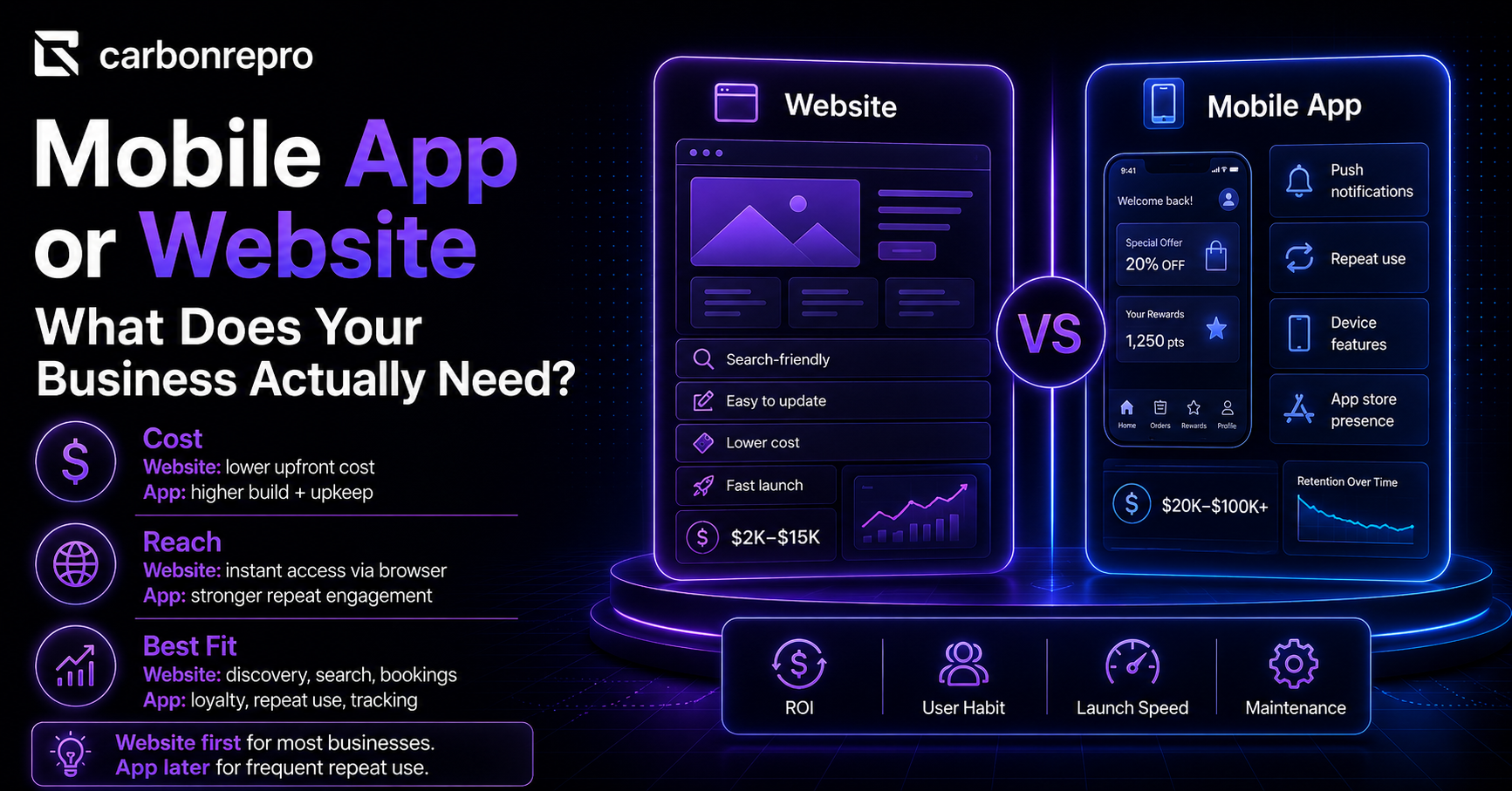
Quick answer: Mobile app vs website for small business comes down to how often customers need you, not which option looks more impressive. Most small businesses need a website first. Only a smaller group needs an app on top of it, usually later, once demand proves it out.
This guide walks through cost, use cases, and a decision framework, so you spend money on the option your customers actually use, not the one that sounds exciting.
Do I need a mobile app for my small business?
Probably not at launch. Ask one question first: will customers open something from you more than once a week? If not, a website covers discovery, browsing, and buying through a browser, with no download. If yes, such as a loyalty program, delivery, or frequent booking, an app starts to earn its cost.
Frequent, repeat use is the strongest signal that points toward an app. Without it, a website answers the need.
Does every business need a mobile app?
No. Many businesses do well without one. Customers find most local and service businesses through search and maps, not app stores, and few people download an app for a company they use a few times a year. An app helps when customers return often or need features a browser handles poorly.
What are the core differences between a mobile app and a website?
A website lives in a browser and anyone can find it through search, a link, or a social post, with no download. An app lives on a phone and is found through an app store. Websites reach more people at first. Apps build stronger habits once installed.
| Website | Progressive web app | Native app | |
|---|---|---|---|
| How people find it | Search, links, social | Search, links, home screen | App store, direct link |
| Install needed | No | Optional | Yes |
| Push notifications | No | Often yes (support varies) | Yes |
| Device features | Limited | Some | Full |
| Typical cost | Lowest | Closer to a website | Highest |
Apps give you push notifications and one-tap access, which build a habit loop. Websites win on reach, since search engines index them and no install step blocks a visitor.
Which is better for marketing, an app or a website?
For attracting new customers, a website usually wins, because search engines index it and anyone can open it with no download. An app is better for keeping existing customers engaged through push notifications and one-tap access. Most businesses use the website to get found, then add an app later for retention.
If you want to be found, start with strong SEO services and, for nearby customers, local SEO.
How much does a mobile app cost compared to a website?
Typical market ranges: a responsive website often runs $2,000 to $15,000, while a native app often runs $20,000 to $100,000 or more per platform. Costs vary by features, team, and location. Apps also carry yearly upkeep, so a website usually wins on both upfront and long-term cost for small businesses.
A few details behind those numbers:
- Websites. A responsive site works on any screen size. A template-based build can cost less. Ongoing costs are usually hosting and occasional updates, often a few hundred dollars a year.
- Native apps. iOS and Android often need separate development, unless you use a cross-platform framework like Flutter or React Native to share code.
- App upkeep. Apps need regular updates to stay compatible with new phone operating systems. App stores charge developer fees, and take a commission on some in-app sales. Yearly maintenance often runs into the thousands.
If you are comparing a responsive website with a mobile app, the website wins on cost for most small businesses. Our website development team builds mobile-friendly sites for small businesses.
When does a small business need an app?
A small business needs an app when customers return often, when it needs phone features a browser cannot handle well, or when a website has already proven demand. Outside those cases, a website answers the need without the extra build and upkeep.
Three situations that point toward an app:
- Frequent repeat visits. A coffee shop loyalty program, a gym class booking tool, or a delivery service customers open several times a week.
- Device features. Camera scanning, real-time GPS tracking, or offline access for field workers without steady internet.
- Proven demand. You already have website traffic and returning visitors, and want to deepen the relationship with your most engaged customers through push notifications and faster repeat access.
Do I need a website if I have a mobile app?
Yes, in almost every case. A website lets customers find you through search, gives app store visitors a place to learn more, builds trust, and hosts support, policies, and contact details. Apps are hard to discover on their own, so the website brings people to the app.
App stores also ask for a privacy policy link and a support page, and these usually live on your website. If you are launching an app, build the website first or at the same time.
What is the difference between a progressive web app and a native app?
A progressive web app (PWA) runs in a browser but can offer home screen icons, offline access, and push notifications. A native app is built for iOS or Android and gets deeper access to phone hardware. A PWA costs closer to a website, while a native app costs more but feels smoother and appears in app stores.
The choice often comes down to budget and what your customers need. A PWA shares much of its code with a website, so it is cheaper to build. A native app gives a faster, store-listed experience that customers associate with established brands.
Support for PWA features varies by phone and browser, so test on the devices your customers actually use.
How do you measure mobile app ROI for a small business?
Track repeat purchase rate, average order value, and customer retention at three, six, and twelve months, plus installs and how many people keep the app. An app pays off only when repeat use drives revenue. Low installs and high drop-off cost money without delivering the engagement you planned on.
Set a baseline before launch so you can compare. If the numbers do not change, the app is sitting unused on customers’ phones.
Should a startup build a website or an app first?
Most startups should build a website first. It validates demand, ranks in search, and costs a fraction of an app to launch and change while you learn what customers want. Budget and runway matter more early on, so cheaper tests come first.
Once a startup proves repeat demand, usually through website traffic and returning visitors, an app becomes a lower-risk investment, because real usage backs the decision instead of a guess.
What does mobile app development cost?
App development cost falls into three rough tiers: simple, mid-level, and complex. Simple apps are often $20,000 to $40,000, mid-level apps $40,000 to $80,000, and complex apps $80,000 and up. Maintenance often adds 15 to 20 percent of the build cost per year. These are typical ranges, not quotes.
- Simple app ($20,000 to $40,000). Basic features such as account login, a content feed, and simple notifications, often built cross-platform to control cost.
- Mid-level app ($40,000 to $80,000). Adds payment processing, GPS tracking, or booking systems, plus backend work to support them.
- Complex app ($80,000 and up). Custom features, heavy integrations, and high security needs, such as apps handling financial transactions or health data.
How do you decide between a mobile app and a website?
Answer four questions before you commit. If you answer no to most of them, start with a website. If you answer yes to most, an app may be worth the investment.
- Does your business depend on frequent, repeat customer interaction? If not, start with a website.
- Do you need device features a browser cannot reach well? If not, a website or PWA likely covers it.
- Can you afford the build and the yearly upkeep? If the number strains your budget, wait and build the website first.
- Have you already validated demand through a website? If not, prove the concept with real traffic and returning visitors before spending app-level money.
Not sure which one your business needs?
carbonrepro is a Houston-based digital marketing and web development agency. Tell us how your customers find and use your business, and we will tell you honestly whether you need a website, an app, or both.
FAQ
Do I need a mobile app for my small business?
Most small businesses do not need an app at launch. A website covers discovery, browsing, and purchase for the majority of customers. An app becomes worthwhile once repeat engagement is proven, such as through loyalty, frequent booking, or delivery.
What is cheaper, a mobile app or a website?
A website is almost always cheaper, both to build and to maintain. A responsive website often costs a few thousand dollars, while a native app often costs tens of thousands per platform, plus yearly upkeep for updates and store requirements. Exact numbers depend on features and who builds it.
When does a small business need an app instead of just a website?
When customers return often, when you need features like camera scanning, GPS, or offline access, or when your website has already shown strong repeat demand. If none of those apply, a website or a progressive web app usually does the job at lower cost.
Is a progressive web app a good middle ground?
For many small businesses, yes. A PWA runs in a browser but can offer a home screen icon, offline access, and push notifications at a cost closer to a website. Support varies by device, and it will not match a native app for deep hardware features.
How do I measure mobile app ROI before building one?
Estimate how many customers would realistically install and keep the app, and what extra revenue repeat use would bring. Compare that to build and yearly upkeep costs. A website with returning visitors is the best test, because it shows real demand before you commit.
Can I build an app or website with a no-code builder?
Often yes for a simple website or a basic app. No-code tools can be a fast, low-cost start. They can limit design, speed, SEO, and integrations as you grow, so check what you can export and change later. Complex features usually need custom work.
Does an app help SEO?
Not directly. Apps are listed in app stores, not indexed like web pages, so they do not replace a website for search visibility. A website, with strong content and technical health, is what brings in search traffic. Use the app for retention.

 Powered by