

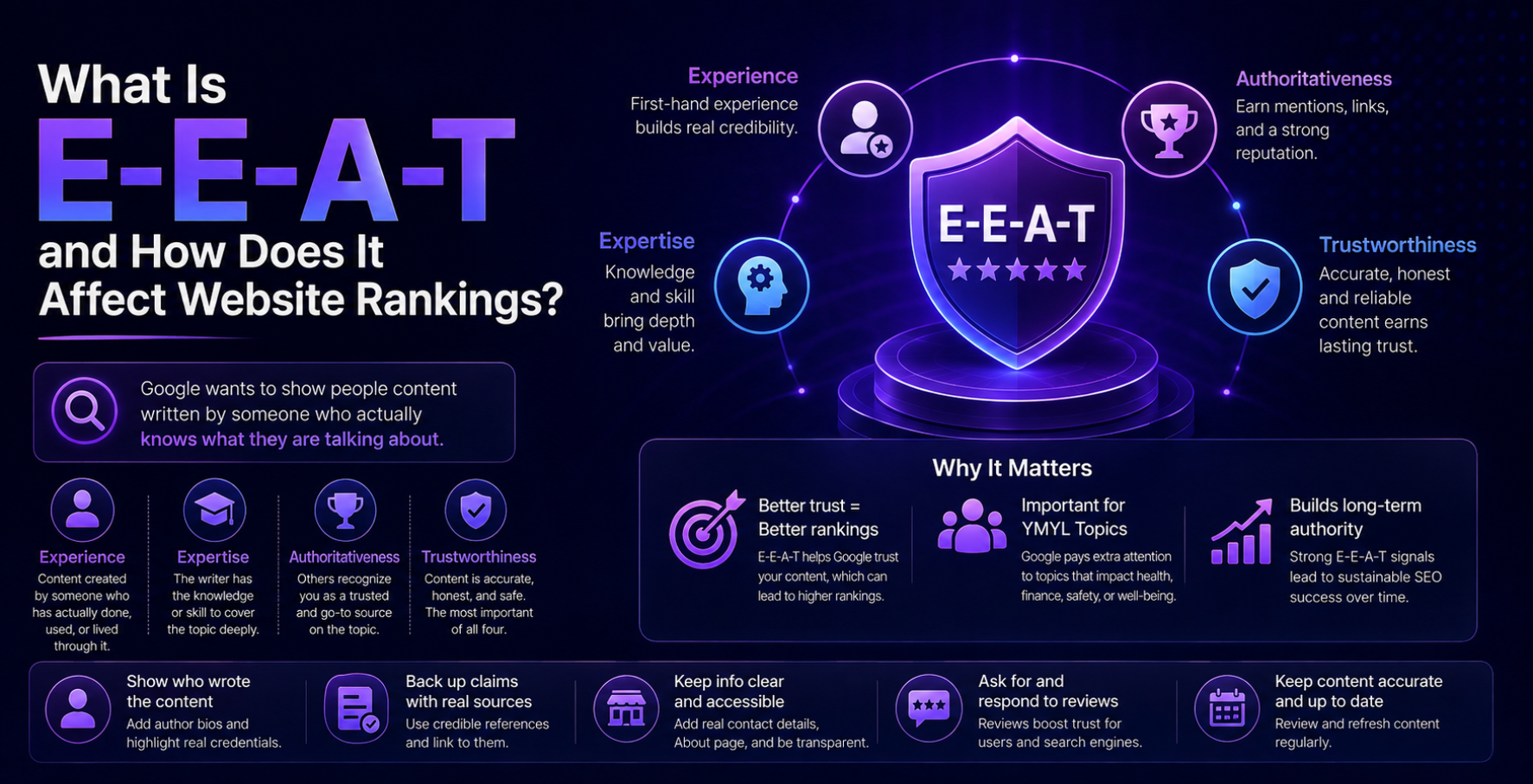
If you have read anything about SEO lately, you have probably run into the term E-E-A-T. It sounds technical, but the idea behind it is simple. Google wants to show people content written by someone who actually knows what they are talking about.
This guide breaks down what E-E-A-T means, where it came from, and what it actually means for your website’s rankings.
What Is E-E-A-T?
E-E-A-T stands for Experience, Expertise, Authoritativeness, and Trustworthiness. It is a framework Google uses to judge the quality of content and the people or businesses behind it. Google’s human quality raters use E-E-A-T to score search results, and that feedback shapes how Google’s ranking systems evolve over time.
What Do the Four Letters Actually Mean?
Each letter covers a different part of what makes content trustworthy.
Experience
Experience means the content was created by someone who has actually done, used, or lived through what they are writing about. A review of a product written by someone who owns it reads very differently from one written by someone who has only read the spec sheet.
Expertise
Expertise is the depth of knowledge or skill the writer has on the topic. A dentist writing about tooth pain carries more weight than a general writer covering the same subject with no background in the field.
Authoritativeness
Authoritativeness is whether other people and websites treat you as a go-to source on the topic. This builds up through mentions, links, citations, and a reputation earned over time, not something you can claim about yourself.
Trustworthiness
Trustworthiness is whether your content is accurate, honest, and safe. Google considers this the most important piece of the four, since even a highly experienced expert loses credibility if their content is misleading or unreliable.
Is E-E-A-T a Ranking Factor?
Not directly. Google has said clearly that E-E-A-T is not a ranking factor on its own. Instead, it is the framework human quality raters use to score search results, and that scoring feeds back into how Google’s ranking systems are trained and improved. In practice, this means E-E-A-T shapes rankings indirectly, through the signals that do count, like content quality, reviews, links, and author credibility.
Where Did E-E-A-T Come From?
The concept started as E-A-T, short for Expertise, Authoritativeness, and Trustworthiness, and it has been part of Google’s Search Quality Rater Guidelines for years. In 2022, Google added the second E for Experience, recognizing that first-hand experience with a topic is its own kind of credibility, separate from formal expertise.
Why Does E-E-A-T Matter More for Some Topics?
Google pays especially close attention to E-E-A-T on topics it calls Your Money or Your Life, often shortened to YMYL. These are topics that could affect someone’s health, finances, safety, or wellbeing, like medical advice, legal guidance, or financial planning. A blog about houseplants can get away with looser sourcing than a page giving investment advice, simply because the stakes are so different.
How Can a Business Improve Its E-E-A-T Signals?
Show Who Wrote the Content
Add clear author names and short bios to your articles, especially anything explaining a service or answering a technical question. If the writer has real credentials or hands-on experience, say so plainly.
Back Up Claims With Real Sources
Link to credible sources when you reference statistics or outside research, and avoid vague claims that cannot be checked. This is one of the fastest ways to signal trustworthiness to both readers and Google.
Keep Contact and Business Information Clear
Make sure your website has an easy-to-find About page, real contact details, and accurate business information. This sounds basic, but a surprising number of sites make it hard to tell who is actually behind the content.
Ask for and Respond to Reviews
Reviews are a visible trust signal for both customers and search engines. Encourage happy customers to leave one, and respond to reviews consistently, including the occasional negative one.
Keep Content Accurate and Up to Date
Outdated information hurts trust even if it was accurate when it was written. Review and refresh older content regularly, especially anything involving prices, regulations, or fast-changing topics.
Common E-E-A-T Mistakes
Publishing content with no clear author. Unattributed articles, especially on technical or YMYL topics, read as less trustworthy to both readers and Google.
Making claims without any backup. Statistics or statements presented with no source behind them weaken trust, even if the claim happens to be true.
Copying competitor content instead of writing from real knowledge. Thin, reworded content rarely demonstrates any real experience or expertise, and it tends to perform worse over time.
Ignoring reviews entirely. A business that never responds to reviews, positive or negative, looks disengaged rather than trustworthy.
Frequently Asked Questions
What does E-E-A-T stand for?
E-E-A-T stands for Experience, Expertise, Authoritativeness, and Trustworthiness. It is the framework Google’s quality raters use to evaluate the credibility of content and the people behind it.
Is E-E-A-T a direct Google ranking factor?
No. Google has stated that E-E-A-T is not a ranking factor on its own. It is used by human quality raters to score search results, and that feedback shapes the signals that do affect rankings.
Why did Google add a second E for Experience?
Google added Experience in 2022 to recognize that first-hand, real-world experience with a topic is its own form of credibility, separate from formal expertise or credentials.
What are YMYL topics?
YMYL stands for Your Money or Your Life. These are topics that can affect someone’s health, finances, safety, or wellbeing, and Google holds content on these topics to a higher E-E-A-T standard.
How can a small business improve its E-E-A-T?
Add clear author bios, back up claims with real sources, keep contact information easy to find, collect and respond to reviews, and keep content accurate and current.
Want Help Building Trust Signals Into Your Content?
Carbonrepro builds content and SEO strategies around real business proof, not filler. If you want to see how this connects to AI search specifically, our guides on answer engine optimization and generative engine optimization cover how trust signals like these carry over into ChatGPT, Gemini, and Google AI Overviews. Reach out and we can review your site’s current trust signals together.



 Powered by